


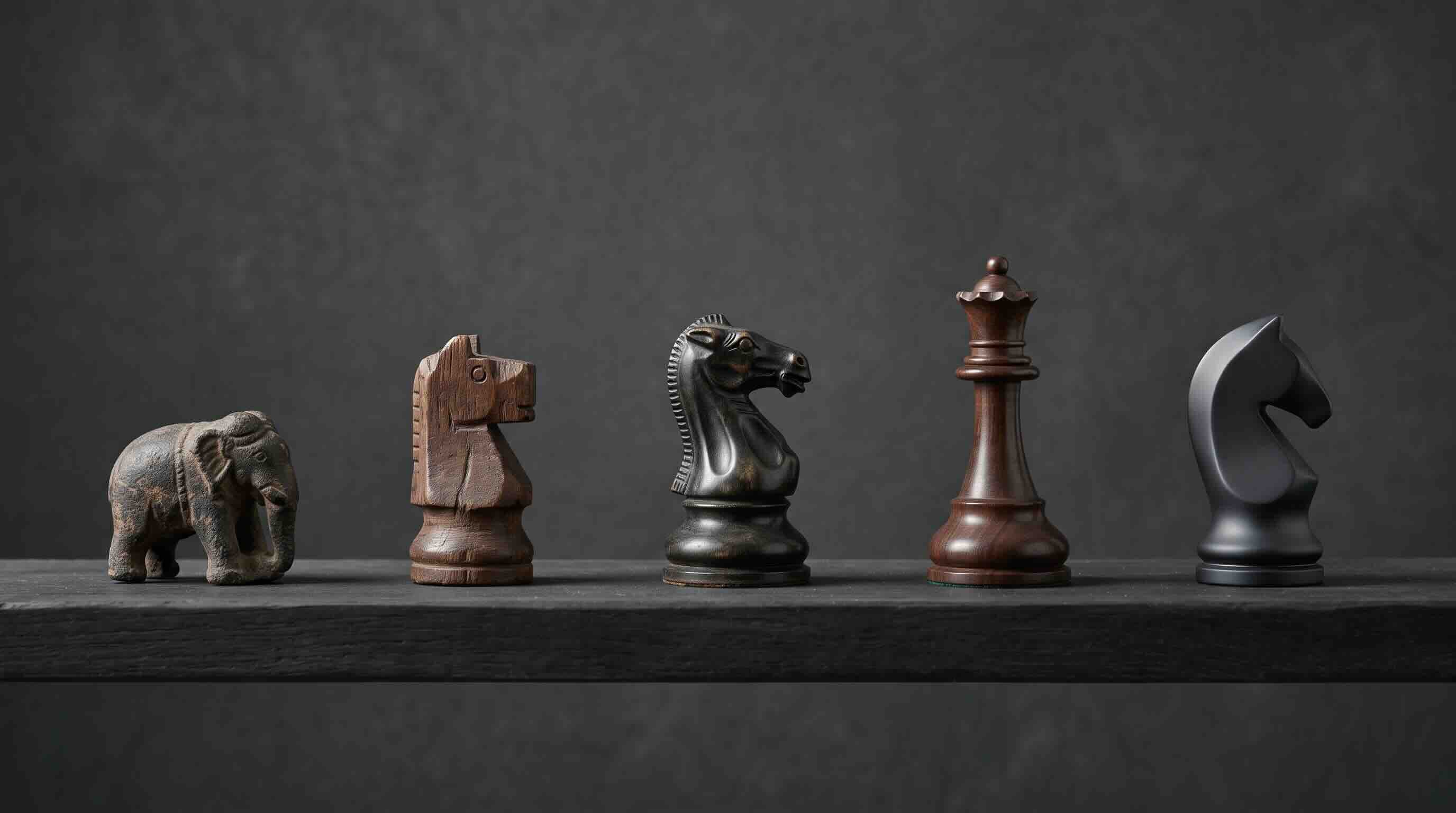
The fascinating journey of Chess: From Chaturanga to modern Chess
Its story is a journey across cultures, with a few surprising rule changes along the way.
Today, chess is played everywhere—from school clubs and living rooms to major international tournaments. But it didn't appear fully formed with queens, castling, and online ratings.
It probably began in India
The early history of chess isn't documented well enough to identify one exact inventor or birthday. Although the game's earliest versions are fundamentally traced back to the ancient Egyptian game of Senet, historians generally trace the game's development to India, where a game called Chaturanga was known by around the sixth century CE.
The name is associated with the four divisions of an army: infantry, cavalry, elephants, and chariots. These military ideas were reflected in the game's pieces and help explain why chess feels like a miniature battle of plans and positioning.
From India to Persia—and beyond
Chess travelled to Persia, where it was known as Chatrang. As the game spread through the Arabic-speaking world, it became known as Shatranj. It then travelled into Europe, helped along by cultural contact and trade.
The game changed as it moved. Pieces didn't always move the way they do today, and the queen was once much less powerful. Imagine trying to launch a spectacular queen attack when your queen could move only one square diagonally!
The queen's big promotion
Around the late fifteenth century, major rule changes in Europe transformed chess. The queen gained the powerful movement we recognise today, and the bishop also became much stronger. These changes made long-range attacks and fast combinations possible, helping create a more dynamic game.
Even the familiar chess pieces have a history. The design now commonly used in tournaments "the Staunton pattern" was introduced in 1849. It was registered by Nathaniel Cooke and promoted by the leading player Howard Staunton.
An ancient game that keeps evolving
In 1924, the International Chess Federation, known as FIDE, was founded in Paris to help organise international chess. Today, players can compete over the board or online, study games with chess engines. This ancient game turned to an e-sport phenomenon which takes place also in E-sports World Cup.
The board may look simple, but its history is anything but. Every game you play connects you to centuries of experimentation, competition, and creativity.
Want to explore openings, replay memorable games, and build your own chess skills? Discover the learning experience at ChessVolt.